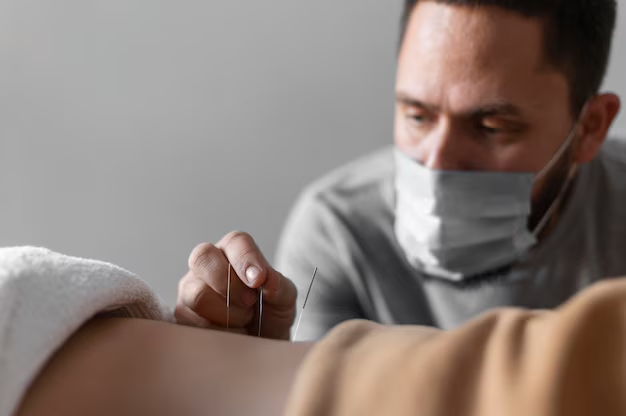
In the first week of a residential stay at Ranch Creek Recovery, a client who called himself sceptical of anything “alternative” agreed to try acupuncture only because a peer in group insisted it had gotten her through the worst of her withdrawal insomnia. Forty minutes later, with five thin needles resting in each ear, he fell asleep sitting upright in a chair, something he said hadn’t happened without medication in over a year. That kind of result is exactly why acupuncture for addiction has quietly become a standard adjunct in many treatment programs rather than a fringe add-on. It doesn’t replace medical detox, therapy, or medication-assisted treatment. It gives the nervous system a low-risk, drug-free way to settle down so the rest of clinical care can take hold.
Acupuncture has roots that go back thousands of years in traditional Chinese medicine. People there believed that using thin needles on certain points could affect how the body feels and how it responds physically. In addiction treatment, the version most programs use isn’t full-body acupuncture at all. It’s a standardized ear-based protocol, delivered in a clinical, evidence-informed way rather than as a spiritual practice, and typically offered alongside individual counseling, group therapy, and medical oversight rather than in place of them.
The National Acupuncture Detoxification Association developed its five-point ear protocol in the mid-1970s at Lincoln Hospital in the South Bronx, and it remains the framework most rehab programs rely on today. Each point targets a different physiological or emotional response, which is part of why it’s used so widely in group settings without requiring patients to talk through what they’re feeling.
| Ear Point | Traditional Association | Common Therapeutic Use |
| Sympathetic | Autonomic nervous system | Easing physical tension and pain |
| Shen Men (“Spirit Gate”) | Calming the mind | Reducing anxiety and agitation |
| Kidney | Willpower and fear | Supporting emotional grounding |
| Liver | Detoxification, irritability | Easing frustration and restlessness |
| Lung | Grief and release | Supporting emotional processing |
Researchers don’t fully agree on the exact mechanism, but the leading theories point to endorphin release and regulation of the autonomic nervous system, the same system responsible for the racing heart, sweating, and restlessness common during withdrawal. Acupuncture treatment for drug addiction is typically introduced during the acute withdrawal phase precisely because of this calming effect, used alongside medical management rather than instead of it. Clients often describe a noticeable drop in physical agitation during a session, even when the underlying craving hasn’t fully resolved.
Beyond withdrawal, acupuncture for addiction recovery is most consistently associated with three overlapping benefits:
None of these benefits tends to show up after a single session. Programs that use acupuncture therapy for addiction effectively usually build it into a recurring schedule rather than offering it as an occasional extra.
Anyone researching acupuncture for addiction deserves a straight answer, and the honest one is that the evidence base is genuinely mixed. Multiple randomized controlled trials have tested the NADA protocol against sham or standard care, and reviews pooling these studies have found a split result, with roughly half showing meaningful benefit for cravings, retention, or withdrawal symptoms and the rest showing no significant difference.
What’s more consistent across the research is safety. Acupuncture carries a very low risk profile compared to most interventions, which is part of why so many programs continue offering it even as researchers keep refining the evidence. The fair summary is that acupuncture works best as a supportive, adjunctive therapy rather than a proven standalone treatment for substance use disorder.
A typical session is straightforward and requires no preparation beyond showing up. People often recline in a padded chair. Sometimes it is just one person, and other times a few people sit together. A practitioner trained for this then puts five small needles into chosen spots in each ear. The needles are sterile and meant for one use only.
The needles stay in for roughly 30 to 45 minutes while the client rests quietly, often in a dimly lit room. There’s little to no pain, and most clients describe the sensation as mild pressure rather than a sting.
Acupuncture tends to be a good fit for a fairly broad range of clients, particularly:
Ranch Creek Recovery has long built its programs around a holistic, non-12-step model that already includes equine-assisted therapy, yoga, and sound healing alongside evidence-based approaches like CBT and DBT. Acupuncture fits naturally into that same framework, offered as one more tool clients can draw on during a 90-day inpatient drug rehab stay or a shorter residential program, depending on what their individualized treatment plan calls for.
As a provider of alcohol addiction treatment California families across the region turn to, Ranch Creek treats acupuncture the way it treats every complementary therapy on offer, as a supportive addition to clinical care rather than a substitute for it.
Many clients report reduced physical agitation and improved comfort during withdrawal, and this is consistent with some but not all clinical research, which is why it’s used as a complement to medical detox rather than a replacement for it.
No, the needles used in ear acupuncture protocols are extremely thin and inserted just under the skin, so most clients describe the sensation as mild pressure rather than pain.
Most programs recommend multiple sessions per week over several weeks, since benefits for cravings, sleep, and anxiety tend to build with consistency rather than appearing after a single visit.
Some clients experience reduced craving intensity, particularly when sessions are paired with individual counseling and other coping strategies, though results vary from person to person.
Yes, Acupuncture is drug-free and non-invasive, which generally makes it safe to use alongside medications like buprenorphine or naltrexone, though it should always be coordinated with the treatment team managing that care.




Space is Limited. Call to Check Availability.
(877) 997-8931